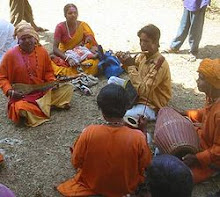
Showing posts with label music notation. Show all posts

Monday, March 8, 2010

Music Notations


Musical notation

Music notation or musical notation is any system which represents aurally perceived music, through the use of written symbols.

Western history

The earliest form of musical notation can be found in a cuneiform tablet that was created at Nippur, Iraq in about 2000 B.C. The tablet represents fragmentary instructions for performing music, that the music was composed in harmonies of thirds, and that it was written using a diatonic scale.[1] A tablet from about 1250 B.C. shows a more developed form of notation.[2] Although the interpretation of the notation system is still controversial, it is clear that the notation indicates the names of strings on a lyre, the tuning of which is described in other tablets.[3] Although they were fragmentary, these tablets represent the earliest recorded melodies found anywhere in the world.[3]

Ancient Greece

Photograph of the original stone at Delphi containing the second of the two hymns to Apollo. The music notation is the line of occasional symbols above the main, uninterrupted line of Greek lettering.

Ancient Greek musical notation was capable of representing pitch and note-duration, and to a limited extent, harmony.[citation needed] It was in use from at least the 6th century BC until approximately the 4th century AD; several complete compositions and fragments of compositions using this notation survive. The notation consists of symbols placed above text syllables. An example of a complete composition is the Seikilos epitaph, which has been variously dated between the 2nd century BC to the 1st century AD. Three hymns by Mesomedes of Crete exist in manuscript. The Delphic Hymns, dated to the 2nd century BC, also use this notation, but they are not completely preserved. Ancient Greek notation appears to have fallen out of use around the time of the Decline of the Roman Empire.

Arab world

Al-Kindi (801–873 AD) was the first great theoretician of Arabic music. He proposed adding a fifth string to the 'ud and discussed the cosmological connotations of music. He surpassed the achievement of the Greek musicians, in using the alphabetical annotation for one eighth. He published fifteen treatises on music theory, but only five have survived.[4] Al-Farabi (872–950), the influential Persian/Turkic polymath, wrote a notable book on music theory entitled Kitab al-Musiqa al-Kabir (The Great Book of Music). His pure Arabian tone system is still used in Arabic music.[5]

Arabic maqam is the system of melodic modes used in traditional Arabic music, which is mainly melodic. The word maqam in Arabic means place, location or rank. The Arabic maqam is a melody type. Each maqam is built on a scale, and carries a tradition that defines its habitual phrases, important notes, melodic development and modulation. Both compositions and improvisations in traditional Arabic music are based on the maqam system. Maqams can be realized with either vocal or instrumental music, and do not include a rhythmic component.

In 1252, Safi al-Din developed a unique form of musical notation, where rhythms were represented by geometric representation. A similar geometric representation would not appear in the Western world until 1987, when Kjell Gustafson published a method to represent a rhythm as a two-dimensional graph.[6]

A theory on the origins of the Western solfège musical notation suggests that it may have had Arabic origins. It has been argued that the solfège syllables (do, re, mi, fa, sol, la, ti) may have been derived from the syllables of the Arabic solmization system Durr-i-Mufassal ("Separated Pearls") (dal, ra, mim, fa, sad, lam). This origin theory was first proposed by Francis Meninski in his Thesaurus Linguarum Orientalum (1680) and then by Jean-Baptiste Thillais Delaborde in his Essai sur la Musique Ancienne et Moderne (1780).[7]

Early Europe

Scholar and music theorist Isidore of Seville, writing in the early 7th century, remarked that it was impossible to notate music.[citation needed] By the middle of the 9th century, however, a form of notation began to develop in monasteries in Europe for Gregorian chant, using symbols known as neumes; the earliest surviving musical notation of this type is in the Musica disciplina of Aurelian of Réôme, from about 850. There are scattered survivals from the Iberian Peninsula before this time, of a type of notation known as Visigothic neumes, but its few surviving fragments have not yet been deciphered.[citation needed]

The ancestors of modern symbolic music notation originated in the Roman Catholic Church, as monks developed methods to put plainchant (sacred songs) to parchment. The earliest of these ancestral systems, from the 8th century, did not originally utilise a staff, and used neum (or neuma or pneuma), a system of dots and strokes that were placed above the text. Although capable of expressing considerable musical complexity, they could not exactly express pitch or time and served mainly as a reminder to one who already knew the tune, rather than a means by which one who had never heard the tune could sing it exactly at sight.[citation needed]

Early Music Notation

To address the issue of exact pitch, a staff was introduced consisting originally of a single horizontal line, but this was progressively extended until a system of four parallel, horizontal lines was standardized. The vertical positions of each mark on the staff indicated which pitch or pitches it represented (pitches were derived from a musical mode, or key).[citation needed] Although the four-line staff has remained in use until the present day for plainchant, for other types of music, staffs with differing numbers of lines have been used at various times and places for various instruments.[vague] The modern five-line staff was first adopted in France and became almost universal by the 16th century (although the use of staffs with other numbers of lines was still widespread well into the 17th century).[citation needed]

Because the neum system arose from the need to notate songs, exact timing was initially not a particular issue because the music would generally follow the natural rhythms of the Latin language. However, by the 10th century a system of representing up to four note lengths had been developed.[citation needed] These lengths were relative rather than absolute and depended on the duration of the neighbouring notes. It was not until the 14th century that something like the present system of fixed note lengths arose. Starting in the 15th century, vertical bar lines were used to divide the staff into sections.[citation needed] These did not initially divide the music into measures (bars) of equal length (as most music then featured far fewer regular rhythmic patterns than in later periods), but appear to have been introduced as an aid to the eye for "lining up" notes on different staves that were to be played or sung at the same time.[citation needed] The use of regular measures (bars) became commonplace by the end of the 17th century.

The founder of what is now considered the standard music stave was Guido d'Arezzo,[citation needed] an Italian Benedictine monk who lived from 995–1050. His revolutionary method—combining a four-line stave with the first form of notes known as 'neumes'—was the precursor to the five-line stave, which was introduced in the 14th century and is still in use today.[citation needed] Guido D'Arezzo's achievements paved the way for the modern form of written music, music books, and the modern concept of a composer.[citation needed]

Modern notation

An example of modern musical notation: Prelude, Op. 28, No. 7, by Frederic Chopin

Modern music notation originated in European classical music and is now used by musicians of many different genres throughout the world.

The system uses a five-line staff. Pitch is shown by placement of notes on the staff (sometimes modified by accidentals), and duration is shown with different note values and additional symbols such as dots and ties. Notation is read from left to right, which makes setting music for right-to-left scripts difficult.

A staff (or stave, in British English) of written music generally begins with a clef, which indicates the position of one particular note on the staff. The treble or G clef was originally a letter G and it identifies the second line up on the five line staff as the note G above middle C. The bass or F clef shows the position of the note F below middle C. Notes representing a pitch outside of the scope of the five line staff can be represented using ledger lines, which provide a single note with additional lines and spaces.

Following the clef, the key signature on a staff indicates the key of the piece by specifying certain notes to be flat or sharp throughout the piece, unless otherwise indicated.

Following the key signature is the time signature. Measures (bars) divide the piece into groups of beats, and the time signatures specify those groupings.

Directions to the player regarding matters such as tempo and dynamics are added above or below the staff. For vocal music, lyrics are written. For short pauses (breaths), retakes (looks like ') are added.

In music for ensembles, a "score" shows music for all players together, while "parts" contain only the music played by an individual musician. A score can be constructed from a complete set of parts and vice versa. The process can be laborious but computer software offers a more convenient and flexible method.

Variations

  • Percussion notation conventions are varied because of the wide range of percussion instruments. Percussion instruments are generally grouped into two categories: pitched and non-pitched. The notation of non-pitched percussion instruments is the more problematic and less standardized.
  • Figured bass notation originated in Baroque basso continuo parts. It is also used extensively in accordion notation. The bass notes of the music are conventionally notated, along with numbers and other signs which determine the chords to be played. It does not, however, specify the exact pitches of the harmony, leaving that for the performer to improvise.
A lead sheet
  • A lead sheet specifies only the melody, lyrics and harmony, using one staff with chord symbols placed above and lyrics below. It is used to capture the essential elements of a popular song without specifying how the song should be arranged or performed.
A chord chart
  • A chord chart or "chart" contains little or no melodic information at all but provides detailed harmonic and rhythmic information, using slash notation and rhythmic notation. This is the most common kind of written music used by professional session musicians playing jazz or other forms of popular music and is intended primarily for the rhythm section (usually containing piano, guitar, bass and drums).
  • Simpler chord charts for songs may contain only the chord changes, placed above the lyrics where they occur. Such charts depend on prior knowledge of the melody, and are used as reminders in performance or informal group singing.
  • The shape note system is found in some church hymnals, sheet music, and song books, especially in the Southern United States. Instead of the customary elliptical note head, note heads of various shapes are used to show the position of the note on the major scale. Sacred Harp is one of the most popular tune books using shape notes.

Notation in various countries

India

Indian music, early 20th century

The Indian scholar and musical theorist Pingala (c. 200 BC), in his Chanda Sutra, used marks indicating long and short syllables to indicate meters in Sanskrit poetry.

In the notation of Indian rāga, a solfege-like system called sargam is used. As in Western solfege, there are names for the seven basic pitches of a major scale (Shadja, Rishabh, Gandhar, Madhyam, Pancham, Dhaivat and Nishad, usually shortened Sa Re Ga ma Pa Dha Ni). The tonic of any scale is named Sa, and the dominant Pa. Sa is fixed in any scale, and Pa is fixed at a fifth above it (a Pythagorean fifth rather than an equal-tempered fifth). These two notes are known as achala swar ('fixed notes'). Each of the other five notes, Re, Ga, ma, Dha and Ni, can take a 'regular' (shuddha) pitch, which is equivalent to its pitch in a standard major scale (thus, shuddha Re, the second degree of the scale, is a whole-step higher than Sa), or an altered pitch, either a half-step above or half-step below the shuddha pitch. Re, Ga, Dha and Ni all have altered partners that are a half-step lower (Komal-"flat") (thus, komal Re is a half-step higher than Sa). Ma has an altered partner that is a half-step higher (teevra-"sharp") (thus, tivra Ma is an augmented fourth above Sa). Re, Ga, ma, Dha and Ni are called vikrut swar ('movable notes'). In the written system of Indian notation devised by Ravi Shankar, the pitches are represented by Western letters. Capital letters are used for the achala swar, and for the higher variety of all the vikrut swar. Lowercase letters are used for the lower variety of the vikrut swar.

Other systems exist for non-twelve-tone equal temperament and non-Western music, such as the Indian svar lippi. New systems that remove handicaps in existing systems are also being developed like Ome Swarlipi.

Russia

In Byzantium and Russia, sacred music was notated with special 'hooks and banners'.

China

Chinese Guqin notation, 1425

The earliest known examples of text referring to music in China are inscriptions on musical instruments found in the Tomb of Marquis Ye of Zeng (d. 433 B.C.). Sets of 41 chimestones and 65 bells bore lengthy inscriptions concerning pitches, scales, and transposition. The bells still sound the pitches that their inscriptions refer to. Although no notated musical compositions were found, the inscriptions indicate that the system was sufficiently advanced to allow for musical notation. Two systems of pitch nomenclature existed, one for relative pitch and one for absolute pitch. For relative pitch, a solmization system was used.[1]

The tablature of the guqin is unique and complex; the older form is composed of written words describing how to play a melody step-by-step using the plain language of the time, i.e. Descriptive Notation (Classical Chinese); the newer form, composed of bits of Chinese characters put together to indicate the method of play is called Prescriptive Notation. Rhythm is only vaguely indicated in terms of phrasing. Tablatures for the qin are collected in what is called qinpu.

The jianpu system of notation (probably an adaptation of a French Galin-Paris-Cheve system) had gained widespread acceptance by 1900. In this system, notes of the scale are numbered. For a typical Pentatonic scale, the numbers 1,2,3,5,6 would be used as notes and 0 as rests. Dots above or below a numeral indicate the octave of the note it represents. Key signatures, barlines, and time signatures are also employed. Many symbols from Western standard notation, such as bar lines, time signatures, accidentals, tie and slur, and the expression markings are also used. The number of dashes following a numeral represents the number of crotchets (4th notes) by which the note extends. The number of underlines is analogous to the number of flags or beams on notes or rests in standard notation. In the present-day jianpu system, the melody is notated alone or with chords. Harmonic and rhythmic elements are left to the discretion of the performers.

Japan

Japanese music is highly diversified, and therefore requires various systems of notation. In Japanese shakuhachi music, for example, glissandos and timbres are often more significant than distinct pitches, whereas taiko notation focuses on discrete strokes.

Indonesia

Notation plays a relatively minor role in the oral traditions of Indonesia. However, in Java and Bali, several systems were devised beginning at the end of the 19th century, initially for archival purposes. Today the most widespread are cipher notations ("not angka" in the broadest sense) in which the pitches are represented with some subset of the numbers 1 to 7, with 1 corresponding to either highest note of a particular octave, as in Sundanese gamelan, or lowest, as in the kepatihan notation of Javanese gamelan. Notes in the ranges outside the central octave are represented with one or more dots above or below the each number. For the most part, these cipher notations are mainly used to notate the skeletal melody (the balungan) and vocal parts (gerongan), although transcriptions of the elaborating instrument variations are sometimes used for analysis and teaching. Drum parts are notated with a system of symbols largely based on letters representing the vocables used to learn and remember drumming patterns; these symbols are typically laid out in a grid underneath the skeletal melody for a specific or generic piece. The symbols used for drum notation (as well as the vocables represented) are highly variable from place to place and performer to performer. In addition to these current systems, two older notations used a kind of staff: the Solonese script could capture the flexible rhythms of the pesinden with a squiggle on a horizontal staff, while in Yogyakarta a ladder-like vertical staff allowed notation of the balungan by dots and also included important drum strokes. In Bali, there are a few books published of Gamelan gender wayang pieces, employing alphabetical notation in the old Balinese script.

Composers and scholars both Indonesian and foreign have also mapped the slendro and pelog tuning systems of gamelan onto the western staff, with and without various symbols for microtones. The Dutch composer Ton de Leeuw also invented a three line staff for his composition Gending. However, these systems do not enjoy widespread use.

In the second half of the twentieth century, Indonesian musicians and scholars extended cipher notation to other oral traditions, and a diatonic scale cipher notation has become common for notating western-related genres (church hymns, popular songs, and so forth). Unlike the cipher notation for gamelan music, which uses a "fixed Do" (that is, 1 always corresponds to the same pitch, within the natural variability of gamelan tuning), Indonesian diatonic cipher notation is "moveable-Do" notation, so scores must indicate which pitch corresponds to the number 1 (for example, "1=C").

Other systems and practices

Cipher notation

In many cultures, including Chinese (jianpu or gongche), Indonesian (kepatihan), and Indian (sargam), the "sheet music" consists primarily of the numbers, letters or native characters representing notes in order. Those different systems are collectively known as cipher notations. The numbered notation is an example, so are letter notation and Solfège if written in musical sequence.

Solfège

Solfège is a way of assigning syllables to names of the musical scale. In order, they are today: Do Re Mi Fa Sol La Ti Do' (for the octave). The classic variation is: Do Re Mi Fa Sol La Si Do' . These functional names of the musical notes were introduced by Guido of Arezzo (c.991 – after 1033) using the beginning syllables of the first six musical lines of the Latin hymn Ut queant laxis. The original sequence was Ut Re Mi Fa Sol La, where each verse would start a note higher. "Ut" later became "Do". The equivalent syllables used in Indian music are: Sa Ri Ga Ma Pa Dha Ni, while the 'bilinear music notation' system offers a fully chromatic method.[citation needed] See also: solfège, sargam, Kodály Hand Signs. In China Xi is used instead of Ti.

Tonic sol-fa is a type of notation using the initial letters of solfège.

Letter notation

The notes of the 12-tone scale can be written by their letter names A–G, possibly with a trailing sharp or flat symbol, such as A♯ or B♭. This is the most common way of specifying a note in English speech or written text.

In Northern Europe, a similar letter system ranging from A to H is used, and instead of the sharp and flat symbols, the syllables "is" (for sharp) or "es" (for flat) are used; e.g. the note a semitone above C is either Cis or Des. H stands for the English B, while Northern European B stands for English B♭.

Tablature

Tablature was first used in the Middle Ages for organ music and later in the Renaissance for lute music.[8] In most lute tablatures, a staff is used, but instead of pitch values, the lines of the staff represent the strings of the instrument. The frets to be fingered are written on each line, indicated by letters or numbers. Rhythm is written separately and durations are relative and indicated by horizontal space between notes. In later periods, lute and guitar music was written with standard notation. Tablature caught interest again in the late 20th century for popular guitar music and other fretted instruments, being easy to transcribe and share over the internet in ASCII format. Websites like OLGA.net (currently off-line pending legal disputes) have archives of text-based popular music tablature.

Klavar notation

Klavar notation (or "klavarskribo") is a chromatic system of notation geared mainly towards keyboard instruments, which transposes the usual "graph" of music. The pitches are indicated horizontally, with "staff" lines in twos and threes like the keyboard, and the sequence of music is read vertically from top to bottom. A considerable body of repertoire has been transcribed into Klavar notation. Klavar notation eliminates the need of accidentals and key signatures, and its advocates claim that this facilitates music-reading.

12-note non-equal temperament

Sometimes the pitches of music written in just intonation are notated with the frequency ratios, while Ben Johnston has devised a system for representing just intonation with traditional western notation and the addition of accidentals which indicate the cents a pitch is to be lowered or raised.

Chromatic staff notations

Over the past three centuries, hundreds of music notation systems have been proposed as alternatives to traditional western music notation. Many of these systems seek to improve upon traditional notation by using a "chromatic staff" in which each of the 12 pitch classes has its own unique place on the staff. Examples are the Ailler-Brennink notation, Jacques-Daniel Rochat's Dodeka system, Tom Reed's Twinline notation, John Keller's Express Stave, and José A. Sotorrio's Bilinear Music Notation. These notation systems do not require the use of standard key signatures, accidentals, or clef signs. They also represent interval relationships more consistently and accurately than traditional notation. The Music Notation Project (formerly known as the Music Notation Modernization Association) has a website with information on many of these notation systems.

Graphic notation

The term 'graphic notation' refers to the contemporary use of non-traditional symbols and text to convey information about the performance of a piece of music. It is used for experimental music, which in many cases is difficult to transcribe in standard notation.[citation needed] Practitioners include Christian Wolff, Earle Brown, John Cage, Morton Feldman, Krzysztof Penderecki, Cornelius Cardew, and Roger Reynolds. See Notations, edited by John Cage and Alison Knowles, ISBN 0-685-14864-5.

Simplified Music Notation

Simplified Music Notation is an alternative form of musical notation designed to make sight-reading easier. It is based on classical staff notation, but sharps and flats are incorporated into the shape of the noteheads. Notes such as double sharps and double flats are written at the pitch at which they are actually played, but preceded by symbols called 'History Signs' to show that they have been transposed. The notation was designed to help people who struggle with sight-reading, including those who suffer from working memory impairments, dyslexia and other learning difficulties.

Parsons code

Parsons code is used to encode music so that it can be easily searched. This style is designed to be used by individuals without any musical background.

Braille music

Braille music is a complete, well developed, and internationally accepted musical notation system that has symbols and notational conventions quite independent of print music notation. It is linear in nature, similar to a printed language and different from the two-dimensional nature of standard printed music notation. To a degree Braille music resembles musical markup languages such as XML for Music or NIFF.

Integer notation

In integer notation, or the integer model of pitch, all pitch classes and intervals between pitch classes are designated using the numbers 0 through 11. It is not used to notate music for performance, but is a common analytical and compositional tool when working with chromatic music, including twelve-tone technique, serial, or otherwise atonal music.

Turntablist transcription methodology

Music notation on computer

Many computer programs have been developed for creating music notation (called scorewriters or music notation software). Music may also be stored in various digital file formats for purposes other than graphic notation output.

Perspectives of musical notation in composition and musical performance

According to Philip Tagg and Richard Middleton, musicology and to a degree European-influenced musical practice suffer from a 'notational centricity', a methodology slanted by the characteristics of notation.[9]

Notation-centric training induces particular forms of listening, and these then tend to be applied to all sorts of music, appropriately or not.[citation needed] Musicological methods tend to foreground those musical parameters which can be easily notated...they tend to neglect or have difficulty with widened parameters which are not easily notated.[citation needed] Examples include the unique vocal style of Joni Mitchell and the String Quartets of Elliott Sharp. Because of the limitations of conventional musical notation, many present-day composers of various genres prefer to compose music which is either not notated, or notated only through the computer language of digital recording.[citation needed]


Patents

Recent US patent 6987220 on a new color based musical notation scheme

In some countries, new musical notations can be patented. In the United States, for example, about 90 patents have been issued on new notation systems. The earliest patent, U.S. Patent 1,383 was published in 1839.

See also


What actually music is !!

Music


Music is an art form whose medium is sound. Common elements of

music are pitch (which governs melody and harmony), rhythm (and its associated concepts tempo, meter, and articulation), dynamics, and the sonic qualities of timbre and texture. The word derives from Greek μουσική (mousike), "(art) of the Muses".

The creation, performance, significance, and even the definition of m

usic vary according to culture and social context. Music ranges from strictly organized compositions (and their recreation in performance), through improvisational music to aleatoric forms. Music can be divided into genres and subgenres, although the dividing lines and relationships between music genres are often subtle, sometimes open to individual interpretation, and occasionally controversial. Within "the arts", music may be classified as a performing art, a fine art, and auditory art.

To many people in many cultures music is an important part of their way of life. Greek philosophers and ancient Indian philosophers defined music as tones ordered horizontally as melodies and vertically as harmonies. Common sayings such as "the harmony of the spheres" and "it is music to my ears" point to the notion that music is often ordered and pleasant to listen to. However, 20th-century composer John Cage thought that any sound can be music, saying, for example, "There is no noise, only sound." According to musicologist Jean-Jacques Nattiez, "the border between music and noise is always culturally defined—which implies that, even within a single society, this border does not always pass through the same place; in short, there is rarely a consensus.... By all accounts there is no single and intercultural universal concept defining what music might be, except that it is 'sound through time'."

History


Prehistoric eras

Ancient music can only be imagined by scholars, based on findings from a range of paleolithic sites, such as bones in which lateral holes have been pierced: these are usually identified as flutes,blown at one end like the Japanese shakuhachi. Instruments, such as the seven-holed flute and various types of stringed instruments have been recovered from the Indus Valley Civilization archaeological sites.India has one of the oldest musical traditions in the world—references to Indian classical music (marga) can be found in the ancient scriptures of the Hindu tradition, the Vedas. The earliest and largest collection of prehistoric musical instruments was found in China and dates back to between 7000 and 6600 BC.

References in the Bible


Music and theatre scholars studying the history and anthropology of Semitic and early Judeo-Christian culture, have also discovered common links between theatrical and musical activity in the classical cultures of the Hebrews with those of the later cultures of the Greeks and Romans. The common area of performance is found in a "social phenomenon called litany," a form of prayer consisting of a series of invocations or supplications. The Journal of Religion and Theatre notes that among the earliest forms of litany, "Hebrew litany was accompanied by a rich musical tradition:"[8]

"While Genesis 4.21 identifies Jubal as the “father of all such as handle the harp and pipe,” the Pentateuch is nearly silent about the practice and instruction of music in the early life of Israel. Then, in I Samuel 10 and the texts which follow, a curious thing happens. “One finds in the biblical text,” writes Alfred Sendrey, “a sudden and unexplained upsurge of large choirs and orchestras, consisting of thoroughly organized and trained musical groups, which would be virtually inconceivable without lengthy, methodical preparation.” This has led some scholars to believe that the prophet Samuel was the patriarch of a school which taught not only prophets and holy men, but also sacred-rite musicians. This public music school, perhaps the earliest in recorded history, was not restricted to a priestly class--which is how the shepherd boy David appears on the scene as a minstrel to King Saul."

Antiquity

Music was an important part of cultural and social life in Ancient Greece: mixed-gender choruses performed for entertainment, celebration and spiritual ceremonies; musicians and singers had a prominent role in ancient Greek theater. In the 9th century, the Arab scholar al-Farabi wrote a book on music titled Kitab al-Musiqi al-Kabir ("Great Book of Music"). He played and invented a variety of musical instruments and devised the Arab tone system of pitch organisation, which is still used in Arabic music.

Western cultures

During the Medieval music era (500-1400), the only European repertory which has survived from before about 800 is the monophonic liturgical plainsong of the Roman Catholic Church, the central tradition of which was called Gregorian chant. Alongside these traditions of sacred and church music there existed a vibrant tradition of secular song. Examples of composers from this period are Léonin, Pérotin and Guillaume de Machaut. From the Renaissance music era (1400-1600), much of the surviving music of 14th century Europe is secular. By the middle of the 15th century, composers and singers used a smooth polyphony for sacred musical compositions. The introduction of commercial printing helped to disseminate musical styles more quickly and across a larger area. Prominent composers from this era are Giovanni Pierluigi da Palestrina, Thomas Morley and Orlande de Lassus.

Allegory of Music, by Filippino Lippi

The era of Baroque music (1600-1750) began when the first operas were written and when contrapuntal music became prevalent. German Baroque composers wrote for small ensembles including strings, brass, and woodwinds, as well as choirs, pipe organ, harpsichord, and clavichord. During the Baroque period, several major music forms were defined that lasted into later periods when they were expanded and evolved further, including the fugue, the invention, the sonata, and the concerto. Composers from the Baroque era include Johann Sebastian Bach, George Frideric Handel and Georg Philipp Telemann. The music of the Classical period (1750-1800) is characterized by homophonic texture, often featuring a prominent melody with accompaniment. These new melodies tended to be almost voice-like and singable. The now popular instrumental music was dominated by further evolution of musical forms initially defined in the Baroque period: the sonata, and the concerto, with the addition of the new form, the symphony. Joseph Haydn and Wolfgang Amadeus Mozart are among the central figures of the Classical period.

In 1800, the Romantic era (1800-1890s) in music developed, with Ludwig van Beethoven and Franz Schubert as transitional composers who introduced a more dramatic, expressive style. During this era, existing genres, forms, and functions of music were developed, and the emotional and expressive qualities of music came to take precedence over technique and tradition. In Beethoven's case, motifs (developed organically) came to replace melody as the most significant compositional unit. The late 19th century saw a dramatic expansion in the size of the orchestra, and in the role of concerts as part of urban society. Later Romantic composers such as Pyotr Ilyich Tchaikovsky and Gustav Mahler created complex and often much longer musical works. They used more complex chords and used more dissonance to create dramatic tension.

Non-Western Classical traditions

Indian classical music is one of the oldest musical traditions in the world. The Indus Valley civilization has sculptures which show dance and old musical instruments, like the seven holed flute. Various types of stringed instruments and drums have been recovered from Harrappa and Mohenjo Daro by excavations carried out by Sir Mortimer Wheeler.[14] The Rigveda has elements of present Indian music, with a musical notation to denote the metre and the mode of chanting. Indian classical music (marga) is monophonic, and based around a single melody line or raga rhythmically organized through talas. Carnatic music is largely devotional; the majority of the songs are addressed to the Hindu deities. There are a lot of songs emphasising love and other social issues. Hindustani music was also influenced by the Persian performance practices of the Afghan Mughals.

Asian music covers the music cultures of Arabia, Central Asia, East Asia, South Asia, and Southeast Asia. Chinese classical music, the traditional art or court music of China, has a history stretching over around three thousand years. It has its own unique systems of musical notation, as well as musical tuning and pitch, musical instruments and styles or musical genres. Chinese music is pentatonic-diatonic, having a scale of twelve notes to an octave (5+7 = 12) as does European-influenced music. Persian music is the music of Persia and Persian language countries: musiqi, the science and art of music, and muzik, the sound and performance of music (Sakata 1983). See also: Music of Iran, Music of Afghanistan, Music of Tajikistan, Music of Uzbekistan.

The music of Greece was a major part of ancient Greek theater. In Ancient Greece, mixed-gender choruses performed for entertainment, celebration and spiritual reasons. Instruments included the double-reed aulos and the plucked string instrument, the lyre, especially the special kind called a kithara. Music was an important part of education in ancient Greece, and boys were taught music starting at age six. Greek musical literacy created a flowering of development; Greek music theory included the Greek musical modes, eventually became the basis for Western religious music and classical music. Later, influences from the Roman Empire, Eastern Europe and the Byzantine Empire changed Greek music.

20th and 21st century music

Double bassist Reggie Workman, tenor saxophone player Pharoah Sanders, and drummer Idris Muhammad performing in 1978

With 20th century music, there was a vast increase in music listening as the radio gained popularity and phonographs were used to replay and distribute music. The focus of art music was characterized by exploration of new rhythms, styles, and sounds. Igor Stravinsky, Arnold Schoenberg, and John Cage were all influential composers in 20th century art music.

Jazz evolved and became a significant genre of music over the course of the 20th century, and during the second half of that century, rock music did the same. Jazz is an American musical art form which originated in the beginning of the 20th century in African American communities in the Southern United States from a confluence of African and European music traditions. The style's West African pedigree is evident in its use of blue notes, improvisation, polyrhythms, syncopation, and the swung note.[16] From its early development until the present, jazz has also incorporated music from 19th and 20th century American popular music. Jazz has, from its early 20th century inception, spawned a variety of subgenres, ranging from New Orleans Dixieland (1910s) to 1970s and 1980s-era jazz-rock fusion.

Rock music is a genre of popular music that developed in the 1960s from 1950s rock and roll, rockabilly, blues, and country music. The sound of rock often revolves around the electric guitar or acoustic guitar, and it uses a strong back beat laid down by a rhythm section of electric bass guitar, drums, and keyboard instruments such as organ, piano, or, since the 1970s, digital synthesizers. Along with the guitar or keyboards, saxophone and blues-style harmonica are used as soloing instruments. In its "purest form", it "has three chords, a strong, insistent back beat, and a catchy melody." In the late 1960s and early 1970s, rock music branched out into different subgenres, ranging from blues rock and jazz-rock fusion to heavy metal and punk rock, as well as the more classical influenced genre of progressive rock.

Performance

Chinese Naxi musicians

Performance is the physical expression of music. Often, a musical work is performed once its structure and instrumentation are satisfactory to its creators; however, as it gets performed, it can evolve and change. A performance can either be rehearsed or improvised. Improvisation is a musical idea created without premeditation, while rehearsal is vigorous repetition of an idea until it has achieved cohesion. Musicians will sometimes add improvisation to a well-rehearsed idea to create a unique performance.

Many cultures include strong traditions of solo and performance, such as in Indian classical music, and in the Western Art music tradition. Other cultures, such as in Bali, include strong traditions of group performance. All cultures include a mixture of both, and performance may range from improvised solo playing for one's enjoyment to highly planned and organised performance rituals such as the modern classical concert, religious processions, music festivals or music competitions. Chamber music, which is music for a small ensemble with only a few of each type of instrument, is often seen as more intimate than symphonic works.

Aural tradition

Many types of music, such as traditional blues and folk music were originally preserved in the memory of performers, and the songs were handed down orally, or aurally (by ear). When the composer of music is no longer known, this music is often classified as "traditional". Different musical traditions have different attitudes towards how and where to make changes to the original source material, from quite strict, to those which demand improvisation or modification to the music. A culture's history may also be passed by ear through song.

Ornamentation

In a score or on a performer's music part, this sign indicates that the musician should perform a trill--a rapid alternation between two notes.

The detail included explicitly in the music notation varies between genres and historical periods. In general, art music notation from the 17th through the 19th century required performers to have a great deal of contextual knowledge about performing styles. For example, in the 17th and 18th century, music notated for solo performers typically indicated a simple, unornamented melody. However, it was expected that performers would know how to add stylistically-appropriate ornaments such as trills and turns. In the 19th century, art music for solo performers may give a general instruction such as to perform the music expressively, without describing in detail how the performer should do this. It was expected that the performer would know how to use tempo changes, accentuation, and pauses (among other devices) to obtain this "expressive" performance style. In the 20th century, art music notation often became more explicit and used a range of markings and annotations to indicate to performers how they should play or sing the piece.

In popular music and jazz, music notation almost always indicates only the basic framework of the melody, harmony, or performance approach; musicians and singers are expected to know the performance conventions and styles associated with specific genres and pieces. For example, the "lead sheet" for a jazz tune may only indicate the melody and the chord changes. The performers in the jazz ensemble are expected to know how to "flesh out" this basic structure by adding ornaments, improvised music, and chordal accompaniment.

Production

Jean-Gabriel Ferlan performing at a 2008 concert at the collège-lycée Saint-François Xavier

Music is composed and performed for many purposes, ranging from aesthetic pleasure, religious or ceremonial purposes, or as an entertainment product for the marketplace. Amateur musicians compose and perform music for their own pleasure, and they do not derive their income from music. Professional musicians are employed by a range of institutions and organisations, including armed forces, churches and synagogues, symphony orchestras, broadcasting or film production companies, and music schools. Professional musicians sometimes work as freelancers, seeking contracts and engagements in a variety of settings.

There are often many links between amateur and professional musicians. Beginning amateur musicians take lessons with professional musicians. In community settings, advanced amateur musicians perform with professional musicians in a variety of ensembles and orchestras. In some cases, amateur musicians attain a professional level of competence, and they are able to perform in professional performance settings. A distinction is often made between music performed for the benefit of a live audience and music that is performed for the purpose of being recorded and distributed through the music retail system or the broadcasting system. However, there are also many cases where a live performance in front of an audience is recorded and distributed (or broadcast).

Composition

An old songbook showing a composition

"Composition" is often classed as the creation and recording of music via a medium by which others can interpret it (i.e. paper or sound). Many cultures use at least part of the concept of preconceiving musical material, or composition, as held in western classical music. Even when music is notated precisely, there are still many decisions that a performer has to make. The process of a performer deciding how to perform music that has been previously composed and notated is termed interpretation. Different performers' interpretations of the same music can vary widely. Composers and song writers who present their own music are interpreting, just as much as those who perform the music of others or folk music. The standard body of choices and techniques present at a given time and a given place is referred to as performance practice, whereas interpretation is generally used to mean either individual choices of a performer, or an aspect of music which is not clear, and therefore has a "standard" interpretation.

In some musical genres, such as jazz and blues, even more freedom is given to the performer to engage in improvisation on a basic melodic, harmonic, or rhythmic framework. The greatest latitude is given to the performer in a style of performing called free improvisation, which is material that is spontaneously "thought of" (imagined) while being performed, not preconceived. Improvised music usually follows stylistic or genre conventions and even "fully composed" includes some freely chosen material. Composition does not always mean the use of notation, or the known sole authorship of one individual. Music can also be determined by describing a "process" which may create musical sounds; examples of this range from wind chimes, through computer programs which select sounds. Music which contains elements selected by chance is called Aleatoric music, and is associated with such composers as John Cage, Morton Feldman, and Witold Lutosławski.

Music can be composed for repeated performance or it can be improvised: composed on the spot. The music can be performed entirely from memory, from a written system of musical notation, or some combination of both. Study of composition has traditionally been dominated by examination of methods and practice of Western classical music, but the definition of composition is broad enough to include spontaneously improvised works like those of free jazz performers and African drummers such as the Ewe drummers.

What is important in understanding the composition of a piece is singling out its elements. An understanding of music's formal elements can be helpful in deciphering exactly how a piece is constructed. A universal element of music is how sounds occur in time, which is referred to as the rhythm of a piece of music. When a piece appears to have a changing time-feel, it is considered to be in rubato time, an Italian expression that indicates that the tempo of the piece changes to suit the expressive intent of the performer. Even random placement of random sounds, which occurs in musical montage, occurs within some kind of time, and thus employs time as a musical element.

Notation

Sheet music is written representation of music. This is a homorhythmic (i.e., hymn-style) arrangement of a traditional piece entitled Adeste Fideles, in standard two-staff format for mixed voices.

Notation is the written expression of music notes and rhythms on paper using symbols. When music is written down, the pitches and rhythm of the music is notated, along with instructions on how to perform the music. The study of how to read notation involves music theory, harmony, the study of performance practice, and in some cases an understanding of historical performance methods. Written notation varies with style and period of music. In Western Art music, the most common types of written notation are scores, which include all the music parts of an ensemble piece, and parts, which are the music notation for the individual performers or singers. In popular music, jazz, and blues, the standard musical notation is the lead sheet, which notates the melody, chords, lyrics (if it is a vocal piece), and structure of the music. Scores and parts are also used in popular music and jazz, particularly in large ensembles such as jazz "big bands."

In popular music, guitarists and electric bass players often read music notated in tablature (often abbreviated as "tab"), which indicates the location of the notes to be played on the instrument using a diagram of the guitar or bass fingerboard. Tabulature was also used in the Baroque era to notate music for the lute, a stringed, fretted instrument. Notated music is produced as sheet music. To perform music from notation requires an understanding of both the rhythmic and pitch elements embodied in the symbols and the performance practice that is associated with a piece of music or a genre.

Improvisation

Musical improvisation is the creation of spontaneous music. Improvisation is often considered an act of instantaneous composition by performers, where compositional techniques are employed with or without preparation. Improvisation is a major part of some types of music, such as blues, jazz, and jazz fusion, in which instrumental performers improvise solos and melody lines. In the Western art music tradition, improvisation was an important skill during the Baroque era and during the Classical era; solo performers and singers would improvise virtuoso cadenzas during concerts. However, in the 20th and 21st century, improvisation played a smaller role in Western Art music.

Theory

Music theory encompasses the nature and mechanics of music. It often involves identifying patterns that govern composers' techniques and examining the language and notation of music. In a grand sense, music theory distills and analyzes the parameters or elements of music – rhythm, harmony (harmonic function), melody, structure, form, and texture. Broadly, music theory may include any statement, belief, or conception of or about music [19]. People who study these properties are known as music theorists. Some have applied acoustics, human physiology, and psychology to the explanation of how and why music is perceived. Music has many different fundamentals or elements. These are, but are not limited to: pitch, beat or pulse, rhythm, melody, harmony, texture, allocation of voices, timbre or color, expressive qualities (dynamics and articulation), and form or structure.

Pitch is a subjective sensation, reflecting generally the lowness or highness of a sound. Rhythm is the arrangement of sounds and silences in time. Meter animates time in regular pulse groupings, called measures or bars. A melody is a series of notes sounding in succession. The notes of a melody are typically created with respect to pitch systems such as scales or modes. Harmony is the study of vertical sonorities in music. Vertical sonority refers to considering the relationships between pitches that occur together; usually this means at the same time, although harmony can also be implied by a melody that outlines a harmonic structure. Notes can be arranged into different scales and modes. Western music theory generally divides the octave into a series of 12 notes that might be included in a piece of music. In music written using the system of major-minor tonality, the key of a piece determines the scale used. Musical texture is the overall sound of a piece of music commonly described according to the number of and relationship between parts or lines of music: monophony, heterophony, polyphony, homophony, or monody.

Timbre, sometimes called "Color" or "Tone Color" is the quality or sound of a voice or instrument.[20] Expressive Qualities are those elements in music that create change in music that are not related to pitch, rhythm or timbre. They include Dynamics and Articulation. Form is a facet of music theory that explores the concept of musical syntax, on a local and global level. Examples of common forms of Western music include the fugue, the invention, sonata-allegro, canon, strophic, theme and variations, and rondo. Popular Music often makes use of strophic form often in conjunction with Twelve bar blues. Analysis is the effort to describe and explain music.

Cognition

A chamber music group consisting of stringed instrument players, a flautist, and a harpsichordist perform in Salzburg

The field of music cognition involves the study of many aspects of music including how it is processed by listeners. Rather than accepting the standard practices of analyzing, composing, and performing music as a given, much research in music cognition seeks instead to uncover the mental processes that underlie these practices. Also, research in the field seeks to uncover commonalities between the musical traditions of disparate cultures and possible cognitive "constraints" that limit these musical systems. Questions regarding musical innateness, and emotional responses to music are also major areas of research in the field.

Deaf people can experience music by feeling the vibrations in their body, a process which can be enhanced if the individual holds a resonant, hollow object. A well-known deaf musician is the composer Ludwig van Beethoven, who composed many famous works even after he had completely lost his hearing. Recent examples of deaf musicians include Evelyn Glennie, a highly acclaimed percussionist who has been deaf since age twelve, and Chris Buck, a virtuoso violinist who has lost his hearing. This is relevant because it indicates that music is a deeper cognitive process than unexamined phrases such as, "pleasing to the ear" would suggest. Much research in music cognition seeks to uncover these complex mental processes involved in listening to music, which may seem intuitively simple, yet are vastly intricate and complex.

Sociology

This Song Dynasty (960–1279) painting, entitled the "Night Revels of Han Xizai", shows Chinese musicians entertaining guests at a party in a 10th century household.

Music is experienced by individuals in a range of social settings ranging from being alone to attending a large concert. Musical performances take different forms in different cultures and socioeconomic milieus. In Europe and North America, there is often a divide between what types of music are viewed as a "high culture" and "low culture." "High culture" types of music typically include Western art music such as Baroque, Classical, Romantic, and modern-era symphonies, concertos, and solo works, and are typically heard in formal concerts in concert halls and churches, with the audience sitting quietly in seats.

Other types of music—including, but not limited to, jazz, blues, soul, and country—are often performed in bars, nightclubs, and theatres, where the audience may be able to drink, dance, and express themselves by cheering. Until the later 20th century, the division between "high" and "low" musical forms was widely accepted as a valid distinction that separated out better quality, more advanced "art music" from the popular styles of music heard in bars and dance halls.

However, in the 1980s and 1990s, musicologists studying this perceived divide between "high" and "low" musical genres argued that this distinction is not based on the musical value or quality of the different types of music.[citation needed] Rather, they argued that this distinction was based largely on the socioeconomics standing or social class of the performers or audience of the different types of music.[citation needed] For example, whereas the audience for Classical symphony concerts typically have above-average incomes, the audience for a rap concert in an inner-city area may have below-average incomes. Even though the performers, audience, or venue where non-"art" music is performed may have a lower socioeconomic status, the music that is performed, such as blues, rap, punk, funk, or ska may be very complex and sophisticated.

When composers introduce styles of music which break with convention, there can be a strong resistance from academic music experts and popular culture. Late-period Beethoven string quartets, Stravinsky ballet scores, serialism, bebop-era jazz, hip hop, punk rock, and electronica have all been considered non-music by some critics when they were first introduced.[citation needed] Such themes are examined in the sociology of music. The sociological study of music, sometimes called sociomusicology, is often pursued in departments of sociology, media studies, or music, and is closely related to the field of ethnomusicology.

Media and technology

A 12-inch (30-cm) 331⁄3 rpm record (left), a 7-inch 45 rpm record (right), which are both analog sound storage mediums, and a CD (above), a digital medium.

The music that composers make can be heard through several media; the most traditional way is to hear it live, in the presence, or as one of the musicians. Live music can also be broadcast over the radio, television or the Internet. Some musical styles focus on producing a sound for a performance, while others focus on producing a recording which mixes together sounds which were never played "live". Recording, even of styles which are essentially live, often uses the ability to edit and splice to produce recordings which are considered better than the actual performance.

As talking pictures emerged in the early 20th century, with their prerecorded musical tracks, an increasing number of moviehouse orchestra musicians found themselves out of work. During the 1920s live musical performances by orchestras, pianists, and theater organists were common at first-run theaters. With the coming of the talking motion pictures, those featured performances were largely eliminated. The American Federation of Musicians (AFM) took out newspaper advertisements protesting the replacement of live musicians with mechanical playing devices. One 1929 ad that appeared in the Pittsburgh Press features an image of a can labeled "Canned Music / Big Noise Brand / Guaranteed to Produce No Intellectual or Emotional Reaction Whatever"

Since legislation introduced to help protect performers, composers, publishers and producers, including the Audio Home Recording Act of 1992 in the United States, and the 1979 revised Berne Convention for the Protection of Literary and Artistic Works in the United Kingdom, recordings and live performances have also become more accessible through computers, devices and Internet in a form that is commonly known as Music-On-Demand.

In many cultures, there is less distinction between performing and listening to music, since virtually everyone is involved in some sort of musical activity, often communal. In industrialized countries, listening to music through a recorded form, such as sound recording or watching a music video, became more common than experiencing live performance, roughly in the middle of the 20th century.

Sometimes, live performances incorporate prerecorded sounds. For example, a disc jockey uses disc records for scratching, and some 20th century works have a solo for an instrument or voice that is performed along with music that is prerecorded onto a tape. Computers and many keyboards can be programmed to produce and play Musical Instrument Digital Interface (MIDI) music. Audiences can also become performers by participating in karaoke, an activity of Japanese origin which centres around a device that plays voice-eliminated versions of well-known songs. Most karaoke machines also have video screens that show lyrics to songs being performed; performers can follow the lyrics as they sing over the instrumental tracks.

Internet

The advent of the Internet has transformed the experience of music, partly through the increased ease of access to music and the increased choice. Chris Anderson, in his book The Long Tail: Why the Future of Business is Selling Less of More, suggests that while the economic model of supply and demand describes scarcity, the Internet retail model is based on abundance. Digital storage costs are low, so a company can afford to make its whole inventory available online, giving customers as much choice as possible. It has thus become economically viable to offer products that very few people are interested in. Consumers' growing awareness of their increased choice results in a closer association between listening tastes and social identity, and the creation of thousands of niche markets.

Another effect of the Internet arises with online communities like YouTube and MySpace. MySpace has made social networking with other musicians easier, and greatly facilitates the distribution of one's music. YouTube also has a large community of both amateur and professional musicians who post videos and comments.[citation needed] Professional musicians also use YouTube as a free publisher of promotional material. YouTube users, for example, no longer only download and listen to MP3s, but also actively create their own. According to Don Tapscott and Anthony D. Williams, in their book Wikinomics, there has been a shift from a traditional consumer role to what they call a "prosumer" role, a consumer who both creates and consumes. Manifestations of this in music include the production of mashes, remixes, and music videos by fans.

Business

The music industry refers to the business industry connected with the creation and sale of music. It consists of record companies, labels and publishers that distribute recorded music products internationally and that often control the rights to those products. Some music labels are "independent," while others are subsidiaries of larger corporate entities or international media groups. In the 2000s, the increasing popularity of listening to music as digital music files on MP3 players, iPods, or computers, and of trading music on file sharing sites or buying it online in the form of digital files had a major impact on the traditional music business. Many smaller independent CD stores went out of business as music buyers decreased their purchases of CDs, and many labels had lower CD sales. Some companies did well with the change to a digital format, though, such as Apple's iTunes, an online store which sells digital files of songs over the Internet.

Education

Non-professional

A Suzuki violin recital with students of varying ages.

The incorporation of music training from preschool to post secondary education is common in North America and Europe. Involvement in music is thought to teach basic skills such as concentration, counting, listening, and cooperation while also promoting understanding of language, improving the ability to recall information, and creating an environment more conducive to learning in other areas.[26] In elementary schools, children often learn to play instruments such as the recorder, sing in small choirs, and learn about the history of Western art music. In secondary schools students may have the opportunity to perform some type of musical ensembles, such as choirs, marching bands, concert bands, jazz bands, or orchestras, and in some school systems, music classes may be available. Some students also take private music lessons with a teacher. Amateur musicians typically take lessons to learn musical rudiments and beginner- to intermediate-level musical techniques.

At the university level, students in most arts and humanities programs can receive credit for taking music courses, which typically take the form of an overview course on the history of music, or a music appreciation course that focuses on listening to music and learning about different musical styles. In addition, most North American and European universities have some type of musical ensembles that non-music students are able to participate in, such as choirs, marching bands, or orchestras. The study of Western art music is increasingly common outside of North America and Europe, such as the Indonesian Institute of the Arts in Yogyakarta, Indonesia, or the classical music programs that are available in Asian countries such as South Korea, Japan, and China. At the same time, Western universities and colleges are widening their curriculum to include music of non-Western cultures, such as the music of Africa or Bali (e.g. Gamelan music).

Academia

Musicology is the study of the subject of music. The earliest definitions defined three sub-disciplines: systematic musicology, historical musicology, and comparative musicology or ethnomusicology. In contemporary scholarship, one is more likely to encounter a division of the discipline into music theory, music history, and ethnomusicology. Research in musicology has often been enriched by cross-disciplinary work, for example in the field of psychoacoustics. The study of music of non-western cultures, and the cultural study of music, is called ethnomusicology. Students can pursue the undergraduate study of musicology, ethnomusicology, music history, and music theory through several different types of degrees, including a B.Mus, a B.A. with concentration in music, a B.A. with Honors in Music, or a B.A. in Music History and Literature. Graduates of undergraduate music programs can go on to further study in music graduate programs.

Graduate degrees include the Master of Music, the Master of Arts, the Doctor of Philosophy (PhD) (e.g., in musicology or music theory), and more recently, the Doctor of Musical Arts, or DMA. The Master of Music degree, which takes one to two years to complete, is typically awarded to students studying the performance of an instrument, education, voice or composition. The Master of Arts degree, which takes one to two years to complete and often requires a thesis, is typically awarded to students studying musicology, music history, or music theory. Undergraduate university degrees in music, including the Bachelor of Music, the Bachelor of Music Education, and the Bachelor of Arts (with a major in music) typically take three to five years to complete. These degrees provide students with a grounding in music theory and music history, and many students also study an instrument or learn singing technique as part of their program.

The PhD, which is required for students who want to work as university professors in musicology, music history, or music theory, takes three to five years of study after the Master's degree, during which time the student will complete advanced courses and undertake research for a dissertation. The DMAis a relatively new degree that was created to provide a credential for professional performers or composers that want to work as university professors in musical performance or composition. The DMA takes three to five years after a Master's degree, and includes advanced courses, projects, and performances. In Medieval times, the study of music was one of the Quadrivium of the seven Liberal Arts and considered vital to higher learning. Within the quantitative Quadrivium, music, or more accurately harmonics, was the study of rational proportions.

Zoomusicology is the study of the music of non-human animals, or the musical aspects of sounds produced by non-human animals. As George Herzog (1941) asked, "do animals have music?" François-Bernard Mâche's Musique, mythe, nature, ou les Dauphins d'Arion (1983), a study of "ornitho-musicology" using a technique of Nicolas Ruwet's Language, musique, poésie (1972) paradigmatic segmentation analysis, shows that bird songs are organised according to a repetition-transformation principle. Jean-Jacques Nattiez (1990), argues that "in the last analysis, it is a human being who decides what is and is not musical, even when the sound is not of human origin. If we acknowledge that sound is not organised and conceptualised (that is, made to form music) merely by its producer, but by the mind that perceives it, then music is uniquely human."

Music theory is the study of music, generally in a highly technical manner outside of other disciplines. More broadly it refers to any study of music, usually related in some form with compositional concerns, and may include mathematics, physics, and anthropology. What is most commonly taught in beginning music theory classes are guidelines to write in the style of the common practice period, or tonal music. Theory, even that which studies music of the common practice period, may take many other forms. Musical set theory is the application of mathematical set theory to music, first applied to atonal music. Speculative music theory, contrasted with analytic music theory, is devoted to the analysis and synthesis of music materials, for example tuning systems, generally as preparation for composition.

Ethnomusicology

Ethnomusicologist Frances Densmore recording Blackfoot chief Mountain Chief for the Bureau of American Ethnology (1916)

Ethnomusicology

In the West, much of the history of music that is taught deals with the Western civilization's art music. The history of music in other cultures ("world music" or the field of "ethnomusicology") is also taught in Western universities. This includes the documented classical traditions of Asian countries outside the influence of Western Europe, as well as the folk or indigenous music of various other cultures. Popular styles of music varied widely from culture to culture, and from period to period. Different cultures emphasised different instruments, or techniques, or uses for music. Music has been used not only for entertainment, for ceremonies, and for practical and artistic communication, but also for propaganda.

There is a host of music classifications, many of which are caught up in the argument over the definition of music. Among the largest of these is the division between classical music (or "art" music), and popular music (or commercial music - including rock music, country music, and pop music). Some genres do not fit neatly into one of these "big two" classifications, (such as folk music, world music, or jazz music).

As world cultures have come into greater contact, their indigenous musical styles have often merged into new styles. For example, the United States bluegrass style contains elements from Anglo-Irish, Scottish, Irish, German and African instrumental and vocal traditions, which were able to fuse in the United States' multi-ethnic society. Genres of music are determined as much by tradition and presentation as by the actual music. Some works, like George Gershwin's Rhapsody in Blue, are claimed by both jazz and classical music, while Gershwin's Porgy and Bess and Leonard Bernstein's West Side Story are claimed by both opera and the Broadway musical tradition. Many current music festivals celebrate a particular musical genre.

Indian music, for example, is one of the oldest and longest living types of music, and is still widely heard and performed in South Asia, as well as internationally (especially since the 1960s). Indian music has mainly three forms of classical music, Hindustani, Carnatic, and Dhrupad styles. It has also a large repertoire of styles, which involve only percussion music such as the talavadya performances famous in South India.

Music therapy

Music therapy is an interpersonal process in which the therapist uses music and all of its facets—physical, emotional, mental, social, aesthetic, and spiritual—to help clients to improve or maintain their health. In some instances, the client's needs are addressed directly through music; in others they are addressed through the relationships that develop between the client and therapist. Music therapy is used with individuals of all ages and with a variety of conditions, including: psychiatric disorders, medical problems, physical handicaps, sensory impairments, developmental disabilities, substance abuse, communication disorders, interpersonal problems, and aging. It is also used to: improve learning, build self-esteem, reduce stress, support physical exercise, and facilitate a host of other health-related activities.

One of the earliest mentions of Music Therapy was in Al-Farabi's (c. 872 - 950) treatise Meanings of the Intellect which described the therapeutic effects of music on the soul. Music has long been used to help people deal with their emotions. In the 17th century, the scholar Robert Burton's The Anatomy of Melancholy argued that music and dance were critical in treating mental illness, especially melancholia. He noted that music has an "excellent power ...to expel many other diseases" and he called it "a sovereign remedy against despair and melancholy". He pointed out that in Antiquity, Canus, a Rhodian fiddler, used music to "make a melancholy man merry, ...a lover more enamoured, a religious man more devout." In November 2006, Dr. Michael J. Crawford and his colleagues also found that music therapy helped schizophrenic patients. In the Ottoman Empire, mental illnesses were treated with music.